
Okaloosa Projected Versus Actual Release
Three labels answer three different questions. FDC's Current Inmate detail uses Current Release Date for a person still in state prison. Florida law calls the gain-time-based calculation a tentative release date. Both are projections. After the person actually leaves FDC custody, the separate Inmate Release record uses Release Date for the completed event.
A Scheduled Termination Date in FDC Supervised Population concerns the expected end of community supervision, not the day the person left prison. A county jail release sheet records the end of the Okaloosa booking. It can instead show transfer to state prison, ICE, or another agency, so even a completed county release is not always a return to the community.
A pretrial detainee usually has no sentence-based release date to calculate. A judge may set bond or enter an order, but the jail must still receive the paperwork and complete identity, property, and hold checks. Okaloosa's Clerk says minute sheets reach the jail after court concludes, sometimes after normal business hours. Court action explains authority; Corrections records the physical release.
Find an Okaloosa Projected Release Date
Start with the agency that holds the person. Okaloosa Correctional Institution is an FDC state prison, so its current records use the statewide search. The Okaloosa County Jail is operated by the county Department of Corrections, and a person held only there may never enter FDC data. The Okaloosa County release-search and records path can help identify the custody system before a date is interpreted.
- Confirm whether the person is in the county jail, an FDC prison, federal custody, or another agency. Do not use a roster disappearance as proof of release.
- For an FDC prisoner, open the Current Inmate search. Use the six-character DC number if known, or search the exact name.
- Open the matching detail and compare photo, DC number, name, aliases, current facility, and sentence cases. Then read the field labeled Current Release Date.
- For a county-jail sentence, inspect the sentencing order and call Okaloosa Corrections at 850-689-5690. Ask for the named booking and release calculation rather than applying the state-prison formula.
- When the date passes, verify the completed event in the right release record. Check the next agency if the record shows a transfer or detainer.
The FDC Current Inmate interface is the official source for a state prisoner's public Current Release Date field.
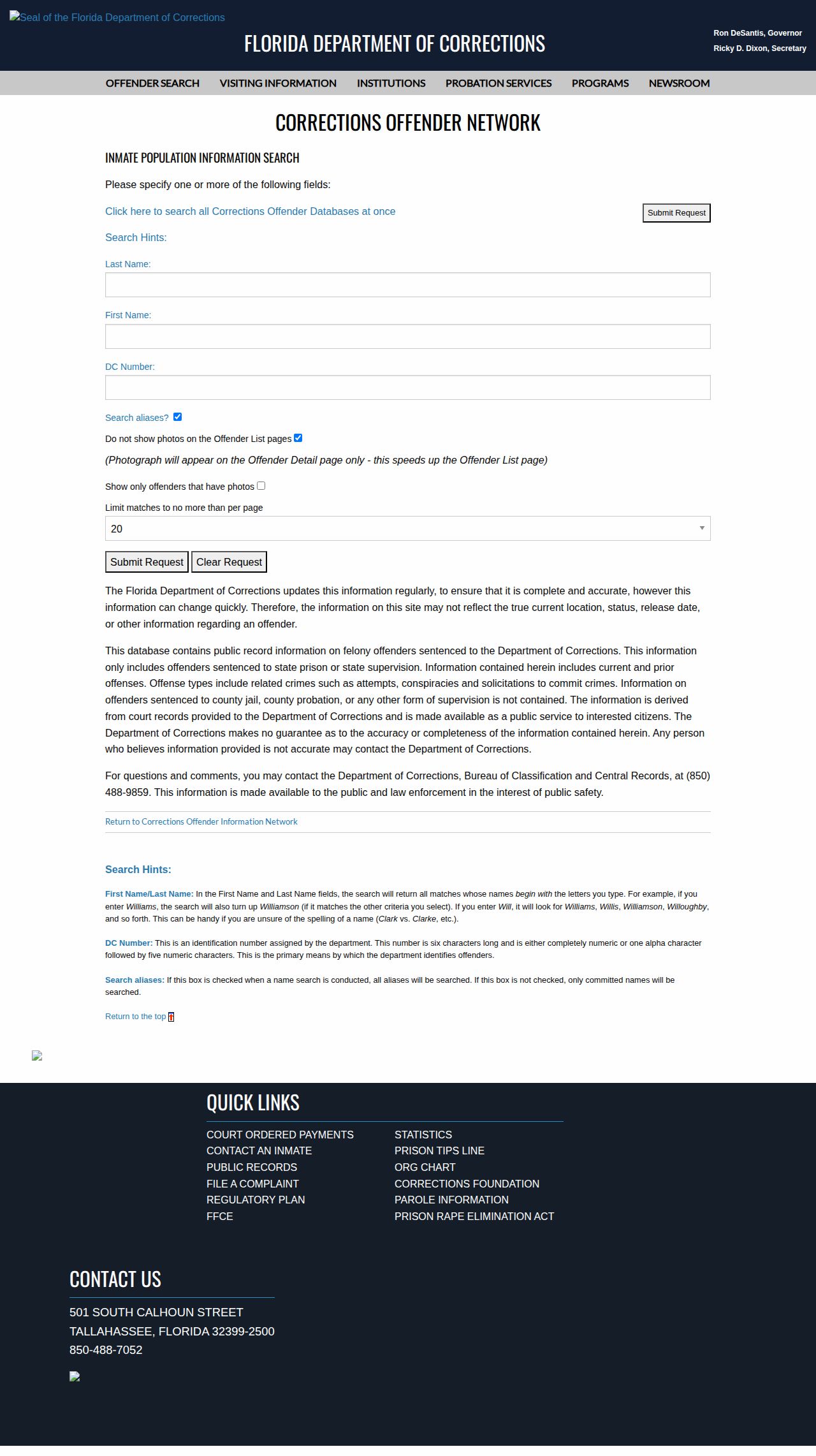
The field belongs to a current state-prison record and should not be read as a completed Okaloosa County jail release.
FDC separates current prisoners, released prisoners, supervised people, and absconders into different searches. That design helps prevent a future Okaloosa release date from being confused with a past event. Current Inmate answers where a state prisoner is held and supplies the public projection. Inmate Release covers people who have been released or are scheduled for release and updates nightly. After a completed event, compare the photo, DC number, Release Date, release context, and sentence cases. Then search Supervised Population for the sanction that may follow.
Note: FDC does not cover a person whose only sanction is county jail or county probation.
Okaloosa FDC Release Date Math
Florida Statutes section 944.275 directs FDC's state-prison calculation. FDC first establishes the maximum sentence-expiration date after lawful jail credit awarded by the court. It then calculates a tentative release date from gain time that has been granted, restored, or forfeited. Gain time is credit administered by FDC under the governing statute. It can move the projection earlier, while forfeiture can move it later, but the tentative date cannot exceed maximum expiration.
The governing rate turns on the offense date. Basic gain time belongs to an older framework for offenses from July 1978 through December 1993. Rules for January 1994 through September 1995 used the former severity level. For an offense on or after October 1, 1995, FDC may award up to ten days per month of incentive gain time, but subsection 944.275(4)(f) bars gain time from releasing the prisoner before service of 85 percent of the sentence imposed. Court credit for time physically incarcerated counts toward the floor.
The 85-percent rule is a minimum, not a promised exit point. Awards can be withheld or forfeited. A one-time education award of up to 60 days may apply to an otherwise eligible prisoner, but it cannot break the same floor. Listed serious offenses carry other exclusions, and life terms, mandatory minimums, or 100-percent provisions can override a simple estimate.
The official tentative-release statute sets out the gain-time terms behind the public projection.
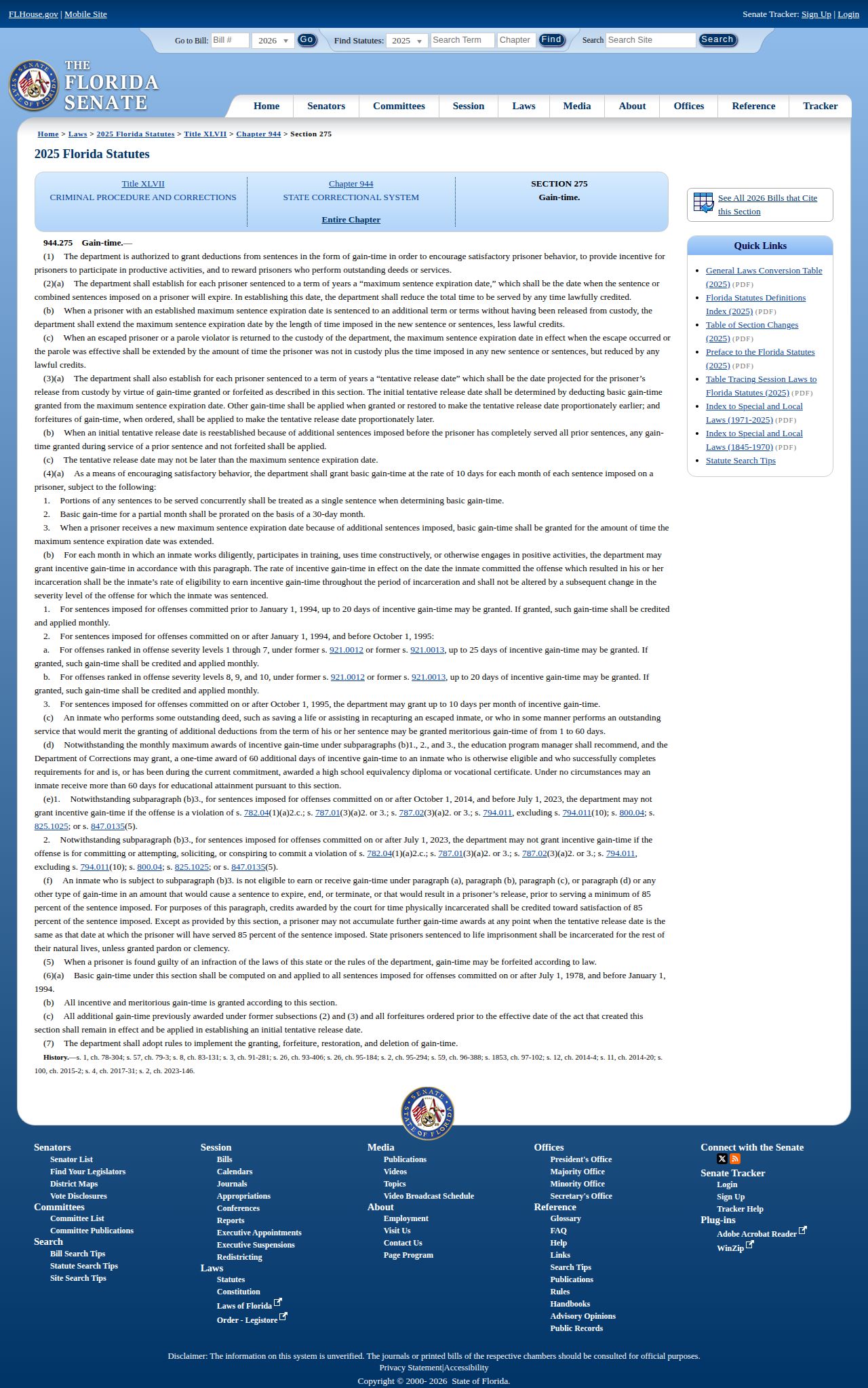
Its rules explain why a rough percentage calculation cannot replace the date maintained by FDC for an Okaloosa state prisoner.
Why Okaloosa Release Dates Change
A current date reflects the information and credits FDC has applied at that point. Later prison discipline can change gain time. A corrected jail-credit award or new court order can change the sentence framework. Multiple cases may run at the same time or one after another. A detainer may not alter the end of FDC custody, yet it can change where the person goes next. The public date must therefore be read with the sentence history and destination record.
| Factor | Possible effect | Record to check |
|---|---|---|
| Gain time granted or restored | May move the tentative date earlier within statutory limits | FDC computation and Current Release Date |
| Disciplinary forfeiture | May move the projection later | FDC gain-time computation |
| Corrected jail credit | Changes credited time in the maximum framework | Court order and FDC record |
| New, concurrent, or consecutive cases | Can alter the controlling term | Sentence history and court judgments |
| Mandatory minimum or 100-percent rule | Limits or blocks an earlier gain-time date | Judgment, offense statute, and FDC calculation |
| Detainer or agency hold | May send the person to another custodian after FDC | Release destination and receiving-agency record |
| Parole or release-program decision | May establish, defer, or revise an anticipated date | FCOR or FDC action and later custody record |
Florida's community-release rule material also refers to some post-1995 tentative dates and statutory 100-percent minimums as non-advanceable. That label is another reason not to assume that all programs or credits can move every date.
Okaloosa Jail Release Date Limits
The state gain-time formula should not be applied to a county-jail sentence. The person may never enter FDC jurisdiction, and local release can turn on the sentencing order, credited time, bond, a purge payment, dismissal, a program, probation, or a hold. Okaloosa's live jail locator is a current-population search. Its detail template contains a Released Date label, but no dependable historical release archive or retention term was found.
Ask Okaloosa Corrections for the actual computation and physical-release record. A focused request through County Risk Management can seek the booking number, admission and release timestamps, release disposition, destination or receiving agency, and holds shown at discharge. ClerkQuest supplies the order and sentence, but the Clerk does not claim its entry is the time the person walked out.
Okaloosa Anticipated Release Notices
Florida Statutes section 944.605 requires FDC to give an anticipated-release notice within six months before sentence expiration, another legal release program, or parole. If an unexpected early release occurs, notice is due as soon as possible. The duty supports advance notice, but it does not freeze the date or turn an estimate into a completed event.
The official anticipated-release notice statute separates the notice process from the final custody record.
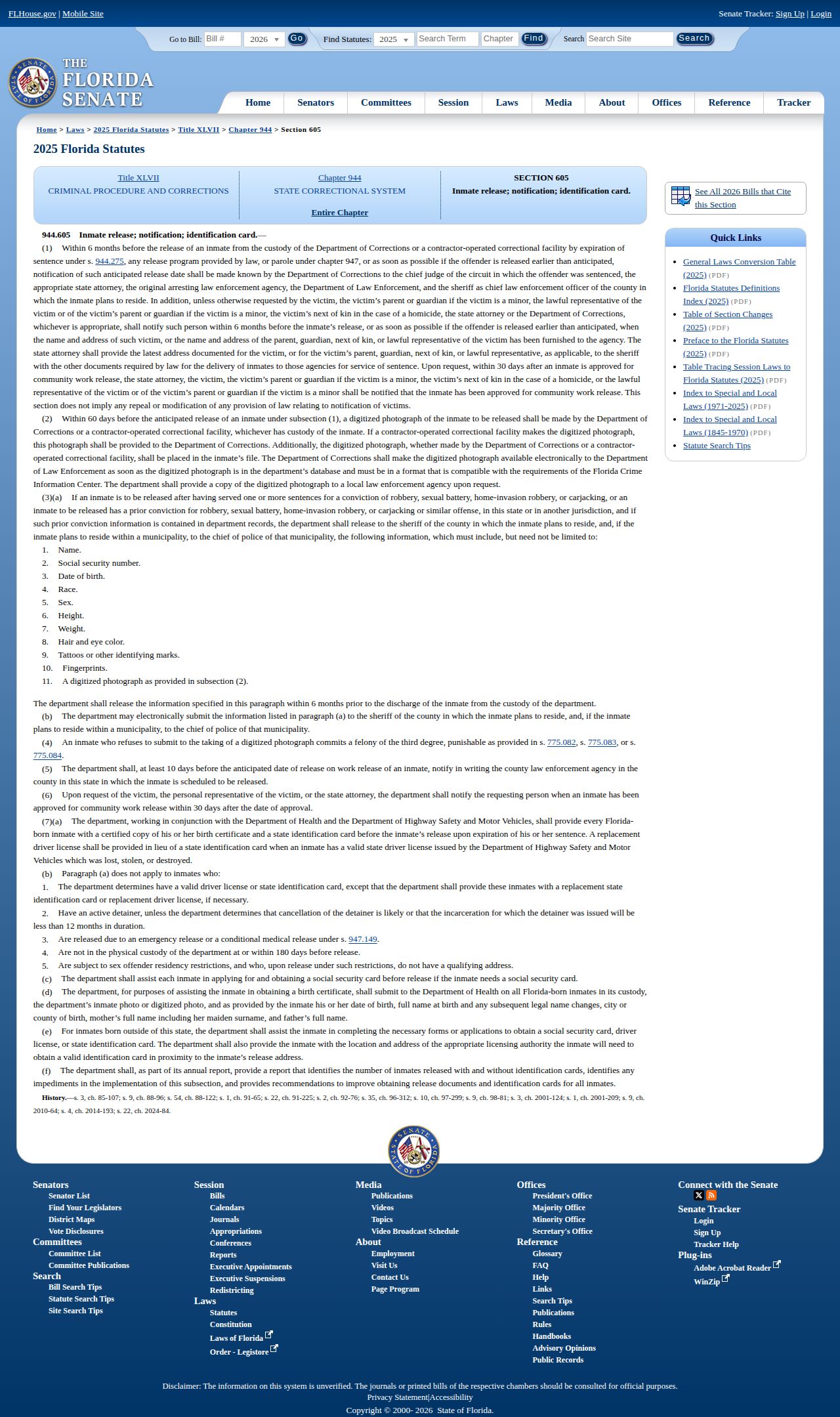
That distinction is vital when a family member or registered recipient receives an estimate that later changes.
Note: An anticipated notice describes an expected event; FDC's completed Release Date remains the record of actual state-prison departure.
Confirm an Okaloosa Release Date
For an FDC prisoner, recheck Current Inmate as the date nears, then use Inmate Release after departure. The completed detail can show Release Date, DC number, photograph, release context, and sentence history. Run Supervised Population next because parole, probation, conditional release, or community control can continue after confinement ends.
When a state date or computation appears wrong, the relevant records channel is FDC rather than the county jail. The Bureau of Admission and Release can be reached at 850-488-9167 or dc.release@fdc.myflorida.com. General Classification and Central Records is at 850-488-9859. A focused public-record request may seek the sentence and gain-time computation, release or discharge record, and the legal credit applied. The request should identify the person by name, aliases, and DC number and should ask for existing records rather than a new calculation.
Florida VINE can provide an offered custody-change notice when registration occurred before the event. The Okaloosa County VINELink check explains the one-person search and notification steps. VINE does not promise a permanent release archive, so retain the notice and verify it with FDC, Okaloosa Corrections, or the receiving agency named in the record.
Federal and immigration dates need different systems. BOP covers sentenced federal custody, while ICE ODLS covers current detainees and certain recent releases. Neither system supplies a county-jail or FDC release date. Match each date to the agency that held the person.