
Okaloosa Parole and Probation Differences
Parole and probation both permit a person to live outside a jail or prison while following stated rules, but they begin in different ways. Probation is a court-ordered sanction that may replace or follow confinement. Parole is a supervised release mechanism for a limited group of Florida prisoners who remain eligible under older or narrow statutory categories. Florida largely ended ordinary parole for later offenses, so a current Okaloosa County record labeled parole should not be assumed from the fact that someone left prison.
Conditional release is different again. Under Florida Statutes section 947.1405, it is mandatory post-prison supervision for defined qualifying groups. The Florida Commission on Offender Review sets its terms, while Florida Department of Corrections field officers supervise the person. Okaloosa County Pretrial Services also facilitates financial and non-financial release before trial. Pretrial release is not parole, and it does not establish a conviction or a completed sentence.
| Supervision type | How it starts | Best verification source |
|---|---|---|
| State probation | A Florida court orders community supervision | FDC Supervised Population and the sentencing case |
| Parole | FCOR acts in an eligible case | FCOR order, then FDC release and supervision records |
| Conditional release | Statute requires post-prison supervision for a qualifying person | FDC supervision detail and FCOR records |
| County-only probation | A county court imposes a local sanction | Okaloosa court file and current local probation contact |
| Pretrial release | A judge authorizes release while the case remains pending | ClerkQuest, Pretrial Services, and the jail release record |
- Discharge
- The formal end of a supervision term or custodial sentence.
- Absconder
- A supervised person who has stopped making himself or herself available to the supervising agency.
- Community control
- A strict form of state supervision in the community, often with more limits than standard probation.
- Scheduled termination
- The date a supervision term is expected to end. It is not the date of physical release from jail or prison.
Verify Okaloosa Post-Release Supervision
For state supervision, the strongest public starting point is the FDC Supervised Population search. Search by the six-character DC number when known. A name search is also available, but common names demand a close match on the photo, aliases, physical details, case history, and DC number. The result can show a supervision begin date, current status, supervision type, current office or location, verified address, and scheduled termination date.
- Decide whether the last custody was the Okaloosa County Jail or an FDC prison. A county-jail departure does not automatically create an FDC record.
- Search FDC Supervised Population by DC number or exact name. Open the matching detail instead of relying on the result list.
- Read Current Status, Supervision Type, Supervision Begin Date, Current Location, and Scheduled Termination Date as separate fields.
- Compare the listed case with the Okaloosa court disposition. This guards against a same-name match and distinguishes state supervision from county-only probation.
- Call the listed local office for reporting logistics or record questions. Do not infer a check-in rule from another person's case.
The Okaloosa County released-inmate search and records path explains how the jail release sheet, court disposition, and destination record fit together. FDC expressly does not cover every person whose only sanction was county jail or county probation. An empty FDC result in that situation is expected and cannot prove that supervision ended.
The official FDC supervision interface shows the fields used to verify an active state case.
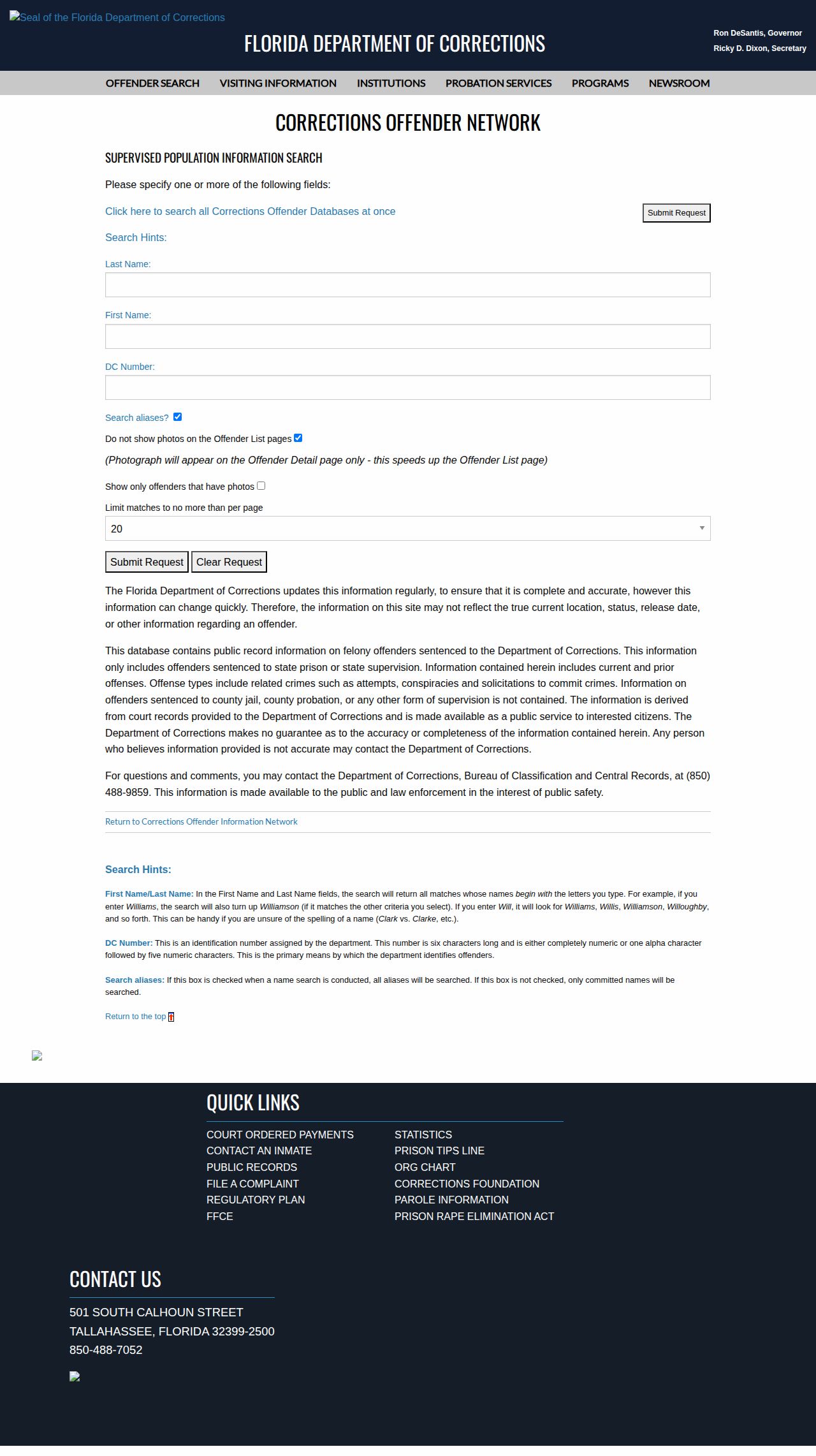
Its separate start, status, location, type, and termination fields prevent a scheduled end date from being mistaken for a prison release date.
Note: A supervision record supports the listed state status, but the supervising office remains the source for current reporting instructions.
Okaloosa Probation Office Contacts
FDC Circuit 1 serves Okaloosa, Escambia, Santa Rosa, and Walton counties. Its official office directory lists two Okaloosa County field offices. The record's Current Location should guide the call because the nearest office is not always the assigned office. General field-services questions may go to 850-717-3444 or co-supervision@fdc.myflorida.com.
FDC Crestview Office 012
250 W. Pine Avenue, Suite A
Crestview, FL 32536
850-689-7804
FDC Fort Walton Beach Office 013
13 Kelly Avenue NE
Fort Walton Beach, FL 32548
850-344-0005
FDC Circuit 1 Administration
2108 Douglas Avenue
Pensacola, FL 32504
850-595-8953
pensacola.cir@fdc.myflorida.com
The FDC Circuit 1 page is the current source for these local office listings.
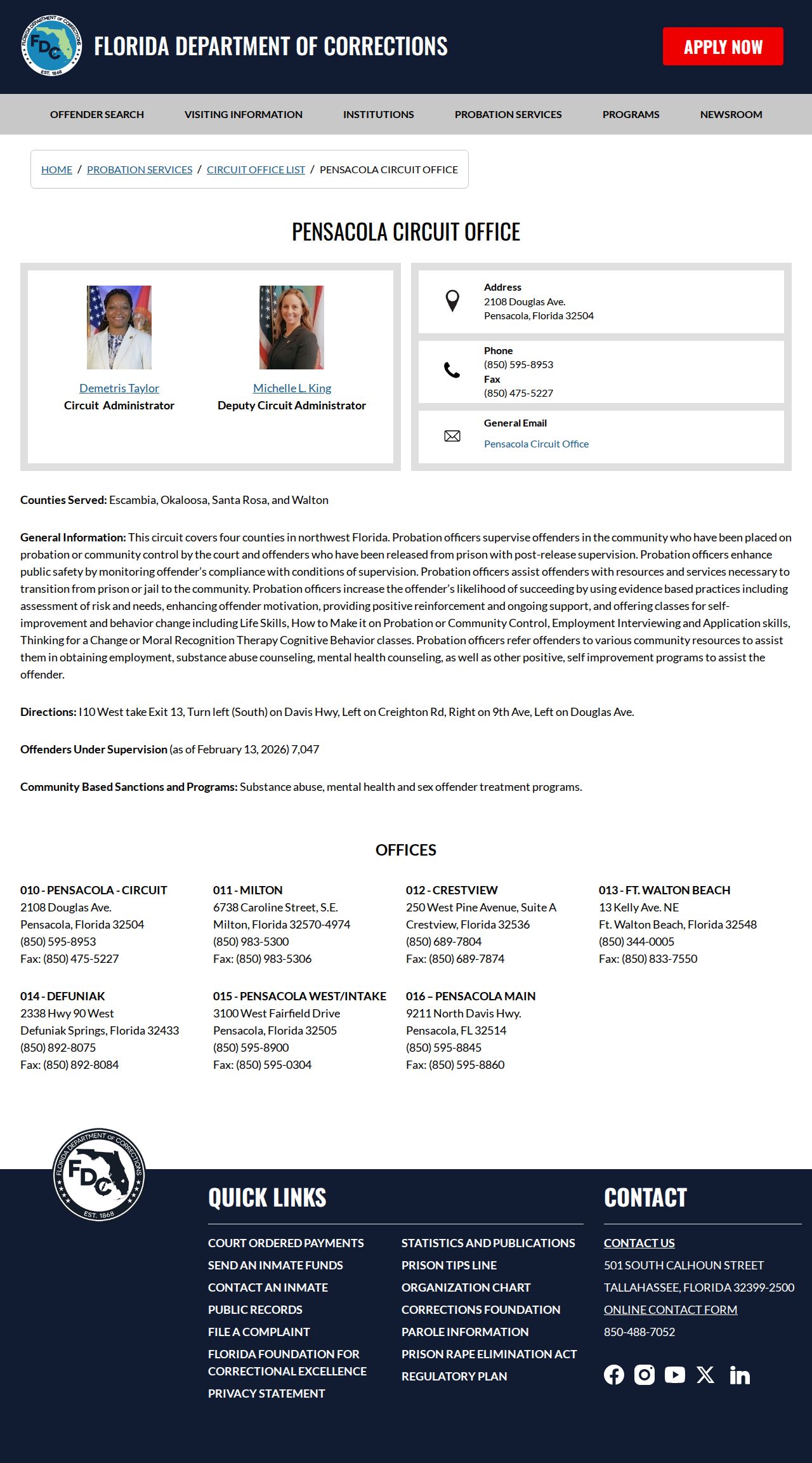
The directory ties Okaloosa County state supervision to Crestview and Fort Walton Beach without implying which office controls a particular case.
Okaloosa Supervision Status Changes
Conditions are the rules attached to an individual order. They can differ by supervision type and case, so a broad web summary cannot establish what one Okaloosa County person must do. A violation allegation also does not equal discharge. It may lead to review, a warrant, revocation, or a court or commission action. Conditional-release revocation can include gain-time consequences, which is one reason release from prison and completion of the full sanction are distinct events.
FDC maintains a separate Absconder and Fugitive search. Use it only to check the specific status it names. The Absconder Unit can be reached at 850-717-3475 on weekdays from 8 a.m. to 5 p.m. A listed person should not be approached. Florida VINE may provide offered custody or supervision change notices, but a VINE alert is not a warrant clearance or a discharge order.
Okaloosa Warrants After Release
Leaving the Okaloosa County Jail roster does not resolve a warrant or prove that the person entered the community. The Okaloosa County Sheriff's Office Warrants Section coordinates warrants, extradition, bond information, transports, and court movement. Its official page does not provide a public name-searchable warrant list. A person may therefore leave one roster because another agency assumed custody.
Check the court case for warrant issue, service, recall, bond, and later orders. Then confirm any transfer with the receiving agency. OCSO Warrants is at 50 2nd Street in Shalimar, 850-651-7432, Monday through Friday from 7:30 a.m. to 4:30 p.m. This local warrant path is separate from the statewide FDC absconder search.
Note: A transfer ends one agency's custody record while detention, a warrant, or supervision may continue under another authority.
Okaloosa Reentry Before Supervision
Okaloosa County has documented local work that starts before release. The county identifies Emerald Coast Life Center as an inside-the-jail partner and calls Anchored a reentry initiative focused on substance use and repeat justice-system contact. Public Safety Coordinating Council minutes also record help with birth certificates, DD-214s, and other official forms. Those details matter because identity papers can support routine reporting and service access after release.
This local preparation is not proof that a named person joined a program, received documents, or completed supervision. It is a resource path. Reporting requirements still come from the court, FCOR, and the assigned FDC or county office. The supervising record should remain the source for the person's status.
Okaloosa Release Property Deadlines
Property issues can continue after a supervised person leaves the Okaloosa County Jail. The county's dated inmate handbook says unclaimed personal property is disposed of after 15 days. Medication and supplies are destroyed after 30 days. A commissary order that arrives after release or transfer must be picked up within 30 days and is not refunded. These are jail property rules, not probation conditions.
Call Okaloosa County Corrections at 850-689-5690 before travel and identify the booking. The posted Inmate Services lobby schedule is Monday through Friday, 8 a.m. to 4 p.m., excluding holidays, but it is not a release-processing schedule. Current instructions should be confirmed with the jail because the handbook is dated and the short deadlines can affect pickup.
Okaloosa Parole Hearing Records
The Florida Commission on Offender Review publishes a voting schedule and a dated agenda system. Agendas may show a name, DC number, county, case, and categories such as an effective interview, parole final hearing, conditional-release review, supervision review, or revocation. A scheduled item is not a grant, denial, or completed release. The current calendar should be checked because meetings do not follow one guaranteed monthly pattern.
Florida Statutes section 947.16 governs initial interview timing for eligible historical categories; it does not award release on the interview date. No public name-based FCOR final-decision database was found. To verify the result, request the FCOR order or file, then compare the later FDC release and supervised-population records. FCOR public records can be requested at fcorlegal@fcor.state.fl.us or 850-848-4460.
The FCOR calendar shows why an agenda entry must be read as scheduled consideration.
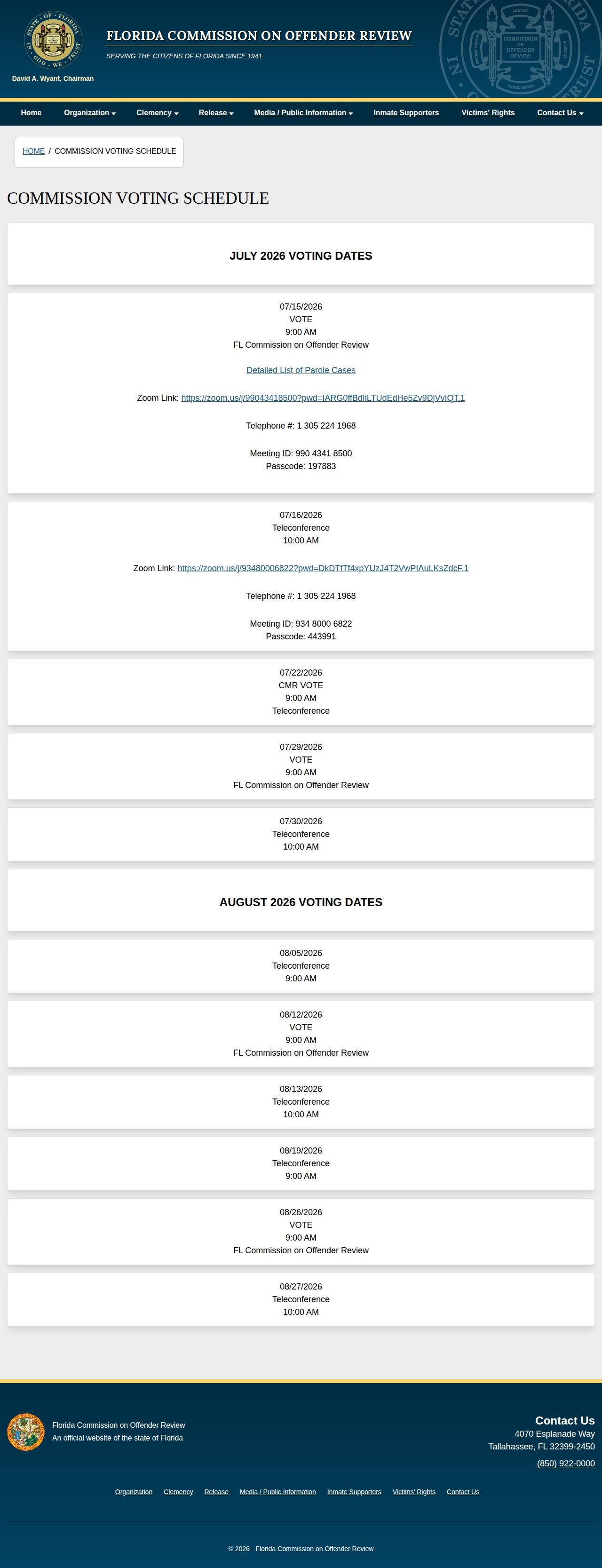
A final physical release still requires a changed FDC custody record, and post-release supervision requires its own FDC status check.
Okaloosa Supervision Discharge Records
Supervision ends through a formal discharge, termination, expiration, or other authorized action shown in the responsible agency and court records. A projected Scheduled Termination Date is useful, but it is not proof that the term ended as planned. Later violations, court orders, FCOR action, or record corrections may change the outcome.
For state supervision, compare the FDC status and history with the court or FCOR order. For county-only probation, use the Okaloosa court file and obtain the probation-termination or completion document when available. A ClerkQuest case marked Closed addresses case administration, not necessarily the precise end of every supervision duty. The discharge record is the sound endpoint.